Government Leader home > August 2005 issue
 August 2005; Vol. 1 No. 3
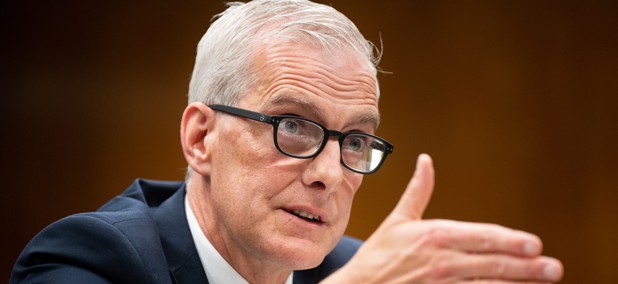
 Sam Mok: Change Agent
 By Richard W. Walker

Labor CFO is at no loss for words on how to lead transformation

The metaphors fly when Samuel T. Mok speaks.

Mok, chief financial officer at the Labor Department, draws from a quiver of images and analogies to illustrate points about issues facing government executives today.

For example, heres Sam Mok talking about how crucial it is for government leaders to keep their eyes on organizational goals and not get bogged down in minutiae:

 |  |
 | Sam Mok
 (Image: photographs by Drake Sorey) |  |
 |
If you start getting hung up on the small things, then you become what I call the proverbial frog at the bottom of the well, where the sky is only as big as the mouth of the well. You fail to recognize that theres a whole world out there. The frogs world is only as big as the mouth of the well. It cant recognize anything else because it has no point of reference.

So my job as a government leader is to get the frogs out of the well, he said.

Mok began getting the frogs out of the well at Labor when he arrived as a political appointee in 2002. As CFO, he sees himself and other government executives as agents in the pushcurrently manifest in the form of President Bushs Management Agendato transform the way government works, to make it more efficient, effective and citizen-centric.

Absolutely. Thats my job, he said.

But change for Mok doesnt mean revolutionary change. I dont believe in coming in with a blowtorch and cleaning out the place, he said.

Mok is more like a turnaround specialist. The turnaround agent comes into an existing place, identifies what needs to be removed and what has to be kept, and builds on that, he said.
Moks self-delineated role as an agent of change runs contrary to the traditional CFO role in government, he thinks.

Most CFOs [in government] are compliance officers, he said. I think thats a problem. They seem to be focused on complying with Office of Management and Budget requirements, [Government Accountability Office] requirements, congressional requirements. CFOs like myself havent done a good job in producing a product that is meaningful and useful to the decision-makers.

Building pyramids. Mok is trying to change that by overhauling Labors financial-management structure. He outlined that effort in terms of another metaphor: pyramids.

The changes we seek can be seen as two pyramids, he said. The pyramids can be described as Before Mok and After Mok.

Mok explained that the Before Mok, or old, pyramid has a thick base of resources dedicated to transaction processing, a slightly less thick layer of reporting activities, a thin layer of analysis and then, at the top, a very small peak of decision support.

In the new, or After Mok, pyramid, thebase consists of a small layer of technology and smart business practices that attenuate the need to expend resources on transaction processing and reporting, a thin layer of report creation, a thick layer of analysis and, at the top, a big capstone of decision support.

In his vision, the nascent, After Mok pyramid will integrate financial and performance data to create useful information for day-to-day and long-term decision-making at the department.

Thats how I see the paradigm shift in this organization, he said. And the bridge for me to take the organization from one pyramid to another is the new financial system were building here, basically our whole accounting system.

Mok sees another dimension to the CFOs role, especially against the backdrop of the major financial scandals in the corporate world in recent years.

I think the role of the CFO is not [to] create the most perfect or correct financial statement, he said. Its how to foster an environment that is ethical, that is trustworthy and has integrity. Then the rest comes easy. I think CFOs are in a prime position to do that.

Where CFOs fit into the whole chief-executive picture is another issue facing government, Mok said.

From where I sit, there are too many chiefs, he said. We have CFOs, chief acquisition officers, CIOs, chief human resources officers. Everybody is a chief and they all have to report to the secretary. At the end of the day, whos on first and how do we coordinate with each other? Thats becoming a fairly significant issue.

He noted the overlap, for example, in CIO and CFO roles. The [Chief Financial Officers Act] talks about the CFO having final responsibility and accountability on financial systems, he said. But the financial system is part of the enterprise architecture and [the Clinger-Cohen Act] gives the CIO the final authority on these matters.

For Mok, there isnt a single solution to the CXO conundrum.

I think its a complex situation, he said. I dont think theres a panacea, theres no silver bullet. Some people dont think its a problem; I dont agree. I dont think we are having warfare going on, but I do think that its a management challenge.

Installing a chief management officer to coordinate CXOs, a move advocated by some government officials, wont solve the problem, Mok said.

Chiefs have own agendas. I dont think having a chief management officer will make the issue go away, because it has a lot to do with organization needs and organizational dynamics and the ability of the different chiefs to balance duties and requirements with each other, he said.

In the end, chiefs have their own agendas and their own perspectives, a situation that must be accepted and leveraged so that government can move toward transformation.

Its kind of like a society with people from many different cultural backgrounds, he said. The challenges we face or share with other [chief executives] are no different than if we had a roomful of people of different ethnicities and cultural heritages. I think the important thing is to identify the differences, learn about those differences and accept each others differences, and then learn how to harness and leverage the differences and the organizational tensions that result from those differences into a high-performance, winning team.

Reaching for another metaphor, Mok compares the situation to a bowl of salad.

Each ingredient is different, he said. Weve got green lettuce, black olives, red tomatoes. They are uniquely different. But cutting, dicing and slicing all of the ingredients into the same shape and size isnt going to make a good salad. I think we all need to respect each others differences, and together we make nutritious food.

Mok credits a stint in the Army in the early 1970s with helping him understand the differences among people and shape his philosophy of leadership.

It became a finishing school for leadership, he said.

Mok, who was born in Shanghai and raised in Hong Kong, came to the United States in his teens.
After earning a bachelors degree in accounting from Fordham University in 1968, he began his career as an auditor in the private sector, serving at the same time in the Army Reserve. In 1971, he went on active dutynot by his own choosing. But it was a circumstance that eventually proved fortuitous.

Because I was traveling 90 percent of the time, I missed a lot of Reserve meetings, so I was called up for active duty, he said. But it was probably the best thing that ever happened to me, because in five years in the military I learned leadership.

As a second lieutenant, Mok confronted a mixed salad of soldiers.

I had to manage people from the South, the North, the Midwest, the rich and the poor, the liberal and conservative, the black and the whitedifferent people who didnt want to be there because they were drafted, he said. So the leadership challenge was incredible. The military really gave me tremendous training in managing people who are different and how to motivate people who dont share your vision.

After the Army, Mok went back to the private sector, serving as director of accounting at Time-Life Books. His years of experience as an auditor also imbued him with skills critical to leadership.

 |  |
 |  | United States Department of Labor |
 |
In auditing, you go in and tell people whats wrong with them, he said. They dont necessarily like it. I had to sit across the table and debate with senior executives, so I learned to get my facts straight. Auditing taught me to be meticulous, to seek corroborating evidence.

In 1986, Mok moved to government service, working as a foreign-service officer at the State Departments Bureau of East Asian and Pacific Affairs. A year later, he entered the Senior Executive Service and was appointed comptroller of the Treasury Department, later becoming Treasury CFO. In 1992, Mok left federal service and went back to the corporate world.

Career, appointee perspective. With his experience as both a federal career executive and a political appointee, Mok brings a special perspective to those roles and how they can be applied to transforming government.

Career and noncareer executives are very different, he said. I have done both, so I can tell you they are very different. Noncareer executives, or political appointees, have a lot shorter shelf life than career executives. My career executives here can think in terms of 20 or 30 years, so their view of the horizon is very different.

Mok said that the primary responsibility of noncareer executives is to provide direction and vision. On the other hand, the career execs can provide day-to-day, practical know-how.
Mok again turned to metaphor to make his point.

Its as if you have a group youre trying to get out of the jungle, he said. The [political executive] has to climb up on the treetop and look at the way we should go. The [career executive] is the one who decides how wide a path you cut.

He added: In this story, the true leader climbs to the top of the tree and [points the] way, but that leader does not necessarily know which blade to use or how wide a path to cut. If the true leader starts getting involved in which blade to use and how wide a path to cut, weve got a problem. Or if [theres] a person whos good at selecting blades and you tell that person to get up on the top of the tree, they may have no clue.

If the career and noncareer executives can partner in that manner, respecting each others differences, you can transform, he said.

Another transformation issue facing government executivesthis one relating to the continuity of leadershipis succession planning, Mok said.

We have huge succession problems in the career ranks, especially among the senior ranks, he said. Current personnel practices in the government are part of the problem.

I have a couple of people here who came in for one reason or another at a fairly low rank and in my opinion they can perform two or three ranks above where they are now, but I cant promote them except once a year, he said. In the private sector, theoretically, you can go from a mailroom clerk to vice president overnight, if somebody thinks you can do it.

Government needs that kind of flexibility, Mok believes.

I wouldnt advocate promoting mail clerks to vice presidents overnight, but we need a little more flexibility than we have, he said. In the military, there is a very defined career path for people to move up from the lower ranks. We dont have that in the federal government now.
The lack of standardized skill-set certification in government also is an impediment to succession planning, he said.

If Mr. X, Y or Z comes to me with certain evaluations in certain skill categories, I have no way of knowing if that evaluation standard is the same as mine. What is excellent for one, because of a low standard, could be horrible for me. If you have external validationobjective testsit solves some of the succession problemthere is more objective measurement how to move people up.

While succession planning and other issues swirling around government transformation are abundantat least in Sam Moks world viewone things for sure: The quest for change by Mok and his fellow executives at Labor is paying off in a big way.

The agency was the first to get to green in all five categories on the most recent Presidents Management Agenda scorecard. In this case, for Mok, theres nothing especially symbolic about that.

His comment? Getting to green is a means, not an end. Too many people think, I got to green, Im done.


|