Skip to Main Content
Government Leader - Managing For Results 1105 Government Information Group
 Current Issue Subscribe eSeminars Jobs About Us
Government Leader home > Jan/Feb 2006 issue


The Advocate

By Richard W. Walker
Photos by Drake Sorey


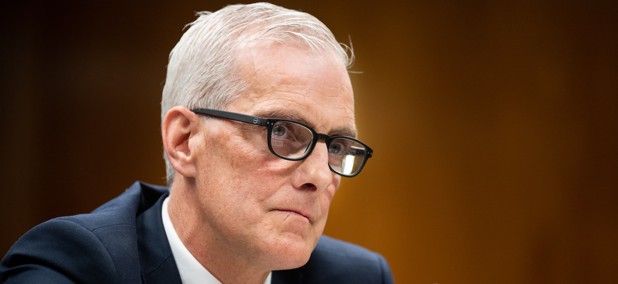
The indefatigable David M. Walker campaigns for fundamental reforms in government

Comptroller General David M. Walker populates his spacious office at the Government Accountability Office in Washington with objects bearing the name or image of his six favorite leaders. It is a formidable aggregation, spanning three centuries: Jefferson and Washington, Lincoln and Lee, Theodore Roosevelt and John F. Kennedy.

“They were forward-looking, innovative, action-oriented and values-driven,” said Walker, head of GAO. “They understood that leaders have a responsibility to try to make a difference but that leadership was more than them. To me, leadership is about getting things done with and through others to achieve positive and sustainable results, both for today and tomorrow.”

The most ubiquitous figure in Walker’s leadership menagerie is Theodore Roosevelt. “There were a lot
of things about him that I would say are admirable,” Walker said. “He was not a staunch partisan. He was not an ideologue. He was a bridge-builder.”

Those words might well describe Walker himself, a political independent who was appointed by President Clinton in 1998 to a 15-year term as comptroller general and head of the nonpartisan GAO.

“He is definitely a bridge-builder who is not viewed as partisan,” said a Washington policy insider.

Now in the middle of his term, Walker has steadily emerged on the national stage as a dynamic and peripatetic advocate of fundamental reforms in government.

“You could say that I am an advocate for truth, transparency, fiscal responsibility and stewardship,” he said. “Those things are by definition not partisan, nor should they be ideological.”

“People talk about red and blue states—politics may be red and blue but the facts don’t have a color,” he added. “Or if they have a color, it’s purple. It crosses all.”

Whether he’s talking to a meeting of Senior Executive Service members in Washington about the virtues of pay for performance, speaking out about out-of-control government spending in a Business Week column or proselytizing before an international forum in Palermo, Italy, for a key national indicators system, Walker is, by all accounts, a force to be reckoned with. “An intellectual powerhouse” was the way another Washington observer put it.


"We do three kinds of work: oversight work, insight work and foresight work." — David Walker

Indeed, by espousing leading-edge concepts such as the key national indicators—a portfolio of economic, social and environmental outcome-based measures that could be used to help evaluate the nation’s position and progress—Walker is laying the groundwork in the long term for public discussion of topics that both major political parties are avoiding, said a policy analyst.

But those who are quick to ascribe the “do as I say, not as I do” label won’t find hypocrisy in Walker’s campaign to reform government. He’s leading by example, transforming his own agency, GAO, into a high-performing organization that will serve as a model for government reform efforts at other agencies.

SETTING AN EXAMPLE. When he arrived at GAO eight years ago, “I wanted to help make sure the GAO was a model federal agency and a world-class professional services organization that just happened to be in the federal government and one that led by example,” he said. “I think we’ve largely met that objective. The challenge is staying there.”

While sustaining its position as a model agency may be GAO’s biggest internal challenge, its external challenges are perhaps more daunting. As a legislative branch agency, GAO must grapple with the colossal trials—particularly in the fiscal arena—faced by its chief clients, the 535 members of Congress.

“The country faces large and growing budget deficits and therefore it’s likely that there are going to be increasing budget constraints in the years ahead,” he said. “One of the first things we have to do is provide more truth and transparency with regard to where we are and where we’re going from a fiscal standpoint. We need to reimpose budgetary controls, both on the spending side and the tax side. We need to engage in a fundamental review of the base of the federal government, which means entitlement reform, discretionary and mandatory spending, and tax policies. [GAO is] in a position to help the Congress make difficult but necessary policy choices.”

Often referred to as the investigative arm of Congress, GAO was until two years ago called the General Accounting Office—even though financial audits represented only about 15 percent of the agency’s workload. The 2004 name change, to the Government Accountability Office, better reflected the scope of GAO’s mission.

Most of GAO’s work involves program evaluations, policy analyses and legal opinions on a broad spectrum of government programs and activities. Simply put, GAO examines the results that agencies are achieving with the taxpayer dollars they receive.

“We do three kinds of work: oversight work, insight work and foresight work,” Walker said.

With Walker at the helm, GAO has honed its ability to meet its mission by hiring career civil servants based on their knowledge, skills and ability. The payoff has been that in the last four years more than 83 percent of the recommendations by GAO analysts to improve government operations have been implemented.

Also under Walker, GAO has scrapped the General Schedule pay system and moved to a performance-based model in which employee compensation is linked to market conditions and pay increases are based on whether an employee meets job expectations.

In revamping GAO’s pay system, Walker sought input from employees to build trust in the new system and minimize culture shock.

“You have to have a very open and inclusive process for determining what to do, how to do it and when to do it,” he said. “You also have to recognize that in the end not everybody is going to agree on the changes you’re going to make but at least everybody will have had an opportunity to be heard and their input will have been considered before final decisions are made.”

Walker must be getting it mostly right. In a survey last year, GAO’s 3,200 employees rated the agency the fourth-best place to work in government (see Government Leader, November 2005, Page 7).

To be sure, Walker is a big believer in the critical importance of people to the government reform effort. (He’s put human capital on the map, said a Washington observer.)

“People are the source of all knowledge, all innovation, all technological enhancements and all process improvements,” he said. “Therefore the organization that attracts, develops and retains the best people will be successful over the long term.”

To do that, agencies have to develop an effective, detailed and credible human-capital plan. “You have to have a people plan,” Walker said. “You have to understand what kind of people you need with what type of skills and knowledge in what relative quantities and in what locations. You also have to know which functions need to be performed by civil servants and which ones might be done by the private sector through contracting. Finally, you need to effectively manage the total workforce.”

Effective planning is perhaps the most vital component in Walker’s strategy for reform. “Failure to plan means you’re likely to fail,” he said.

Walker said that most agencies have strategic plans in place now, compared to about five years ago when very few did.

GAO didn’t have a strategic plan until year 2000. Having a plan has “made a tremendous difference in helping to make sure that we’re making the maximum use out of the resources we get,” he said. “It’s helped us maximize value, manage risk and think more strategically.”

WANTED: A STRATEGIC PLAN. Walker, ever on the conceptual cutting edge, has recently started beating the drum for an executive-branch strategic plan.

“The executive branch doesn’t have a comprehensive strategic plan and it never has,” he said. “It needs to have one. A budget is not a plan—it’s a resource allocation; it may set some priorities but they are short-term priorities. We need a longer-range, more strategic and integrated plan for the executive branch.”

Walker suggested that, ideally, the executive branch’s strategic plan would be developed by the Office of Management and Budget on behalf of the president.

Such a plan would provide a framework for administration initiatives and for helping executive branch agencies make sure that their own planning and execution is consistent with overall executive branch objectives, he said.

Walker’s striking capacity for leadership on crucial issues is rooted in his career background, which blends experience in both the public and private sectors.

Before his appointment as comptroller general, he worked for nearly a decade for Arthur Andersen LLP, where he was a partner and global managing director of its human-capital services practice in Atlanta.

While at Arthur Andersen, Walker also served as a public trustee for Social Security and Medicare from 1990 to 1995. Before that, from 1987 to 1989, he was assistant secretary for pension and welfare benefits at the Labor Department.

“I had leadership experience in both the public and private sectors,” he said. “I think the combination of those experiences helped me to be well-positioned to perform effectively [as comptroller general].”

His experiences in both sectors also have helped Walker understand how private-sector practices might be applied in government—market-based wage systems, for example. But those experiences also have allowed him to apprehend the limitations of private-sector techniques in government.

“The public sector is fundamentally different than the private sector. Culturally, it’s very different. The purpose is different and how you measure success is different,” he said. “In the private sector, most success measures are very quantitative: it’s the top line, it’s the bottom line, it’s market capitalization, it’s stock price, it’s personal compensation.”

“In the public sector,” he continued, “some things are quantitative, such as results, but it’s also doing the people’s work and therefore a lot of the outcomes are qualitative rather than quantitative.”

Moreover, what motivates people to perform in the private sector is different than what motivates them in the public sector, he said.

“Most people in the public sector are motivated to make a difference,” he said. “They are big believers in the word ‘we’ rather than the word ‘me.’ Most people in the public sector are looking to make a difference and grow intellectually. They want to be compensated reasonably but they’re not in it to maximize their net worth; they’re in it to maximize their self worth and to make a difference for the country and their fellow citizens.”

In leading GAO, Walker strives for a management style that is open and encourages participation and yet is resolute and decisive.

“I believe in getting input from a broad spectrum of people in order to make the most informed decisions. I also believe that the buck stops at my desk and that I must make decisions when agreement cannot be reached,” he said.

Ultimately, leaders have a responsibility not only to generate positive results and continuously improve their organizations’ performance but to leave their organizations better off than when they arrived and better positioned for the future, Walker contended.

“That’s what stewardship is all about,” he said.

With about seven years left in his tenure as comptroller general, no one’s expecting Walker to let up in his pursuit of truth and transparency in government. And he doesn’t either.

“I’m blessed with having a very high energy level and hope that it will last,” he said.


This Issue
The Advocate

Private Lives

Performance Anxiety

Performance Anxiety: Results-Based Pay: Springer heralds the winds of change


Shoulder
David Walker’s Leadership Principles
David Walker, comptroller general and head of the Government Accountability Office, offers six guiding principles for government managers:

1 Have a plan that focuses on results. If you fail to plan, you are more likely to fail. Effort is important, but it’s results that count most.

2 Lead by example. Practice what you preach and set a high standard for others to follow.

3 Do what is right. Recognize that the law is the floor of acceptable behavior and that the right decision is many times not the most popular one. 4 Innovate and communicate. Think outside the box and have active and ongoing two-way communications efforts both internally and externally.

5 Partner for progress. Promote internal teaming and external alliances to maximize value and mitigate risk.

6 Be a steward. True leaders don’t just leave things better off than when they arrived, they also leave things better positioned for the future.


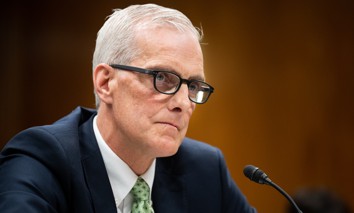
 David M. Walker
  Purchase A Reprint Link To This Page

 Sponsorship Information and Announcements

Top Stories from GCN


 Search

 Archives
 Print Edition
 E-Letters